Thursday, January 2, 2014

ESPN Certification

DCI recently branched out into the world of sports transmission when we received ESPN technical qualification during a visit to Bristol, CT with our HD1 satellite truck!  While the radio frequency (RF) section is essentially the same, there are a lot of differences between doing news and backhauling sports.  DCI is proud to have a truck that meets both the demands of sports backhaul, as well as major news events.


Transmission paths:  Covering a large news story for an organization like AP or EBU may require multiple satellite paths, sometimes 5 or more. Multiplexers are commonly used.  Most sports broadcasts only require 1 path.

Audio:  News is typically 2 channels, sporting events can have up to 16!

Chroma:  With all the motion in a sporting event, they are often broadcast with higher-quality compression techniques, such as 4:2:2 and 10-bit sampling.

Bitrate:  Again with lots of motion, high bitrates are a must.  This lends itself to larger transmitters and higher gain antennas that may be impractical for some news events where a compact SNG van may be the only way to park.

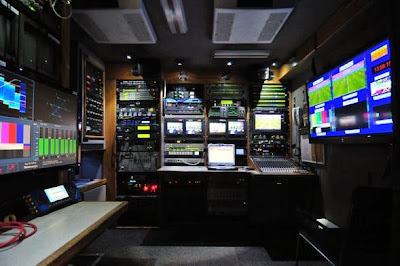
Monitoring:  Being able to monitor all 16 channels of audio, and multiple points along the transmission path is a must for trucks wanting to work for the largest sports channels.  Simultaneous multi-point monitoring the the quickest way to isolate where a potential problem is.  DCI uses a 10-channel Miranda multi-viewer to accomplish this, it can display several video sources on one large monitor.  In a sports transmission, it would be used to monitor the primary and backup inbound program, a locally decoded stream (pre uplink) a return feed off the satellite, and the network's final product via a DirecTV system.  ESPN also requires additional monitoring equipment not necessarily found on news trucks, such as ASI stream monitoring (to monitor the quality of the MPEG stream from the encoder) and also SDI eye pattern analysis, to determine the quality of the serial digital signal coming into the truck. 

The multi-viewer is also handy for important news events, here the system is fully monitoring a 3-path interview with NSA Director Keith Alexander, all on one screen.  Our Miranda multi-view system allows preset screen layouts to be quickly recalled for different kinds of events.  A single path sporting event with 8 audio channels would have a totally different layout, with fewer but larger panels, and more audio meters. 

Comms:  News requires multiple phone lines, typically 2 per path for IFB and intercom and the audio  interfaces to go with them.  A sports backhaul only requires a simple stand-alone intercom to connect with the production truck.  Some trucks that service only sports backhauls are not even equipped to do a news live shot. 

Four reporters from 4 different channels all need to hear their home anchors (IFB), and the producer needs to talk to the camera operators.  This is level of comms is foreign territory for a sports-only backhaul truck! 


Redundancy:  Our HD1 sat truck has 6 encoders that are all available for use with the understanding that if a producer wants to use all 6 paths, if one fails there will not be a backup for it.  The fact that there are 5 other paths typically means that doing 6 is not "mission critical".  If failure becomes a concern, some extra encoders can be brought, maybe 2 spares for 6 live.  But it would be very uncommon to have a full 6 backups for the 6 live paths.  But in sports, there is always one backup for each transmission path.  Since most sports backhauls are only 1 path, most trucks that do sports have 2 encoders, and they are always exactly matching pairs down to the firmware that runs them to enable the fastest switchover in the event of a problem.  For multiple independant news liveshots, matching encoders are not necessary. 

Matching HD encoders for a sports broadcast. 


Self-Sufficiency:  Covering a news event, especially while using a flyaway or at a natural disaster, the uplink engineer must be self-sufficient.  Each camera that comes into the truck must be checked for quality, the operation of the generator, electrical loading for lights, HVAC, cabling, communications... all must be handled by the engineer.  Often things are happening at a quick pace as a story develops, at a breaking story there is pressure to get a signal up immediately after arrival.  For sports, the pace is usually a little slower, as the events are pre-planned and should allow ample setup and testing time. At a sporting event, the uplink truck is often the last piece in a chain where dozens of people are in charge of different areas of a show.    A large production trailer takes care of everything except the physical transmission of the program to the broadcasters.  While the uplink engineer should be mindful of issues such as an over-exposed camera or clipping audio coming into the truck, these problems are usually addressed by other people quickly, whose only job is to adjust the cameras, or handle audio.


Four 53' Double Expando production trucks cover the World Cup Biathlon in Fort Kent, Maine.  While the crews of these trucks pulled 15 miles of camera cables throughout the course, the uplink only needed about 50 feet, and that was provided by the production truck, and power was pulled by the electrician/generator operator.  None of this massive setup was a worry of the uplink engineer, who only had to send one signal to Europe and figure out how not to freeze when walking from the crew shuttle to the truck.

The exact opposite in Haiti after the earthquake, where EVERYTHING was the uplink engineer's problem!  There were no electricians to balance the power load, no generator tech to keep the engine running, no grips to run cables...

DCI's ESPN single path / 16 channel transmission certification means we are rated to broadcast events watched by millions of people with the required monitoring and backup for such a high-profile event.  We can bring this same level of quality-assured transmission to any sporting event, from major leagues down to small college games!  With extensive news experience around the world and now high-level sports certification, DCI is a well-rounded company able to tackle any kind of transmission requirement, anywhere.  Contact DCI to see how we can put out experience to work for you in 2014. 


Thursday, October 10, 2013

ASI Muxing

One of the biggest advantages of DVB (digital video broadcasting) transmission is the ability to transmit compressed video in a fraction of the bandwidth required for analog FM video.  While encoding profiles have improved over the years, taking off with MPEG-2 and moving on to the current standard H.264 (MPEG-4) video, the basic transport stream that contains that data has remained the same.  This signal is called ASI, or Asynchronous Serial Interface, which is based on a 270mbps clock, the same as the SD-SDI video interface, which allows it to pass through the same routers that handle SDI video.  While SDI carries uncompressed serial data at 3 common bitrates (270mbps for SD, 1.5gbps for HD, and 3.0gbps for 1080p HD) ASI caries a transport stream of compressed MPEG data.

One of the elements of the transport stream is Packet Identifiers, or PIDs.  There is one PID number for each component of a transport stream coming out of an encoder, commonly there are two- one for video and one for a single audio pair.  More complex streams can add additional PIDs for extra audios, closed captioning, or other ancillary data.

A transport stream analyzer showing the PIDs from a simple encoder.  The PID number is shown, along with its content and total bandwidth on a bar graph.  Here, the audio is 196kbps and the video is 4.2mbps, for a total stream of around 4.4mbps.


Typically, in the news gathering world, there is one encoder per signal on the satellite, known as a SCPC, or Single Channel Per Carrier.  On a busy satellite you may see dozens of these small signals next to each other.  A single truck can transmit multiple SCPC signals for doing multiple video paths.

A device called a Multiplexer can take several ASI inputs from several encoders, combine all their PIDs (reassigning if necessary to avoid duplicates) and output all that on a single ASI stream for uplink.  In the process it can drop PIDs, reassign them to different channels, even rename the channels themselves.   This is known as a MCPC or Multiple Channel Per Carrier signal.  This is the same technology DirecTV uses to transmit their channels to homes, although their muxes take it one step further by dynamically adjusting encoder bitrates based on content for optimal use of bandwidth, using a closed-loop system known as Statistical Multiplexing, or Stat Mux.  There are advantages to both SCPC and MCPC...


A complex MCPC stream containing multiple channels, some with HD H.264 encoding and 4 pairs of audio (8 channels) for surround sound or multiple languages, along with some standard stereo feeds with SD MPEG-2 video encoding, all within the same stream.  A multiplexer allows different kinds of encoded streams- from simple to complex- to be combined on a new stream.  "Unknown" represents newer audio and video encoding methods that this analyzer does not recognize.


A spectrum view showing 4 SCPC carriers on the left, and one large MCPC on the right, which may contain dozens of channels.  Note- the size of a carrier does not necessarily mean its SCPC or MCPC, a full 36MHz transponder of HD MPEG-2 video is a SCPC, and a 9 MHz signal can contain a MCPC of several SD H.264 channels.  An ASI stream analyzer can show exactly what is contained in a signal.  DCI's HD1 satellite truck and teleport have these advanced diagnostic tools.

Both of DCI's trucks and flyaway uplinks are equipped with Adtec DTA-3050 ten-channel muxes.  They are not commonly used in the truck, but they are an excellent tool to have available.  The flyaway however, is designed to use the mux exclusively for multiple path transmission.

Benefits of mux transmission:
More efficient use of bandwidth.  Separate, individual signals must leave space between the carriers to avoid interference.  This is called guardband and is basically wasted space since there is no data being transmitted there.  A single 18MHz carrier will carry more data than three 6MHz carriers with guardband between.  Error correction is also not needlessly repeated.
Linearity.  This is the primary reason we use muxing on the flyaway. As more individual signals are fed into a typical tube amplifier, intermod is generated, which are spurious signals on harmonics of the primary signals.  As more signals are added to the amplifier, more intermod is generated, and the amplifier must be run at a lower power to avoid these spurious signals from causing interference to other users of the satellite.  So a 400w amplifier may only be able to use 200w before the intermod becomes unacceptable.  By using a single signal to carry the required number of paths, the amplifier can be run at a much higher level.  This is one of the main reasons we can operate so many paths off a small airline-checkable flyaway dish.
Less Equipment.  Using SCPC, each path requires a modulator to go with the encoder. The modulator takes the ASI and turns it into a radio signal.  Using MCPC, all the encoders feed into the mux, and that feeds a single modulator.  Of course, for redundancy we always carry a spare modulator, but it saves a lot of space to not need a modulator for every transmission path. 


ASI analysis of a mux carrier from Lousiania PBS.  This mux also contains some data channels.
 Disadvantages of muxing:
Availability.  Unlike individual carriers that can be turned on and off on demand, a mux is a single carrier and it is not possible to remove paths without reconfiguring the entire mux and changing the modulator and receiver settings for a new bandwidth.  In a news event, a client may want to add and remove extra paths as the story requires to save money on bandwidth.  Using a mux, that is not possible.  Muxes are best suited for feeds where the number of paths required is likely to stay the same. 

The mux remains a very powerful tool in our kit to allow previously impossible results from our flyaway uplink. Contact DCI to learn how we can apply this and other technologies to your video transmission needs.


Wednesday, August 14, 2013

150th Anniversary of the Battle of Gettysburg

Last month DCI produced two large multi-camera webcasts for the 150th anniversary of the battle of Gettysburg.  Whether its webcasting a feed from an overseas satellite broadcast, simple one camera webcast to a full-on production with multiple cameras, full graphics suite and playback, DCI can handle any webcast need, no matter how large or small.  Our production in Gettysburg included two cameras for multiple guests, a long-lens camera, bump shot, and even a wide view camera up on a 40-foot mast, all switched in our production uplink truck and fed back to DCI using efficient HD H.264 DVB transmission where it was encoded for the web.


 ATEM 1M/E switcher and audio board for the production setup in the satellite truck.

 The two-camera interview stage also included a monitor for program return, and another showing a multiviewer of all five cameras.

The second day set, which included some rain in the morning.

Setting up a 33x lens and camera on the roof of the truck to capture the reenactment of Pickett's Charge.

Interview with best-selling author Jeff Shaara.

Creating lower-thirds graphics on the fly as guests came on the show.


Thursday, May 23, 2013

3D Live Surgey- first ever!

  
 One of three seperate locations at the San Diego convention center, this is a 3000' seat auditorium with huge projection monitors, which really highlighted the quality difference between our HD satellite feeds and video conference systems. 
Control room for the above auditorium, with the Boxline Box equipment occupying a small corner of the graphics table.  


When most people think of 3D video, big blockbuster movies come to mind.  3D-TV has not really penetrated the home market as quickly as HD for example.  Most of the content available to home viewers is produced content, not live video.  As a live transmission company, producing a live 3D broadcast presented a lot of challenges in uncharted waters.  DCI recently worked with Boxline Box medical communications to transmit the first-ever live broadcast of a 3D surgery at the American Urology Association (AUA) annual convention in San Diego, CA.   While most medical broadcasts are done via videoconference, Boxline's highly experienced Operating Room video staff and DCI's quality-obsessed field uplink engineers combine perfectly to produce the best looking live broadcasts in the medical communications industry.


DCI and Boxline Box have worked together for several years to coordinate the transmission aspects of live surgery broadcasts.  We handle brokering satellite trucks, coordinating space segment, and doing quality-control of the live feeds from our teleport to ensure the highest quality picture possible in the bandwidth available.  Boxline Box handles the OR video production, return audio so the attendees can ask questions of the operating surgeon, and switching the local feed at the convention.  When an event is big enough, DCI will travel to personally handle the transmission.  Such an event is the AUA annual conference, held this year in San Diego, where we downlink three or four simultaneous HD feeds from trucks we coordinate all over the country.


Three separate HD live surgeries. 


The AUA conference includes a lot of live video from the daVinci robotic surgical system, which natively works in 3D for the surgeon doing the procedure.  All the previous feeds we have done were all standard 2D HD, but this year we stepped it up a level to provide the same 3D HD video seen by the operating surgeon. 


daVinci system surgical "tools" including the 3D scope.  The cameras are contained inside the green cylinder and lenses are at the tip of the scope. 


A surgeon controls a live daVinci robot.  There is also an electronic simulator with the same console but the robot arms are virtual. 


Because the data required to carry uncompressed 3D HD video exceeds the 1.5gbps defined in SMPTE-292M, commonly known as HD-SDI, there are two ways to carry this content.  SMPTE 424M is the most simple within a production plant, it uses a single coaxial cable with a data rate of around 3.0gbps.  This interface is commonly referred to as 3G-SDI, although the "G" stands for gigabit, not "Generation" as 3G cellular standards.  The only problem with 3G-SDI is very few HD encoders and receiver/decoders used by satellite trucks and teleports are capable of handling it, and the few that do require expensive license keys which no one has purchased due to the lack of 3D transmission requests.

 Competing for attention was a display of two grotesquely large human kidney stones. 


Testing the 3D HDMI converter with a uplink from DCI that same day.


The second standard is known as dual-link SDI, defined in SMPTE 372M.  This standard is nothing more than two HD-SDI signals running on two cables, one for each "eye" in a 3D video system.  Converting back and forth between 424M and 372M is fairly simple using a converter such as a Matrox MC100.  We can transmit a dual-link signal using two encoders and two receiver/decoders.  Doing two paths is no big issue for most trucks, the issue for a 3D broadcast is both decoded video signals must arrive at exactly the same time.  Slight variation in firmware or seldom adjusted settings like GOP (group of pictures) and PAFF (Picture-adaptive frame-field) can cause millisecond propagation delay (the delay inherent in any encoding/decoding and satellite transmission system) differences that can throw off the picture when both "eyes" are combined on the viewing monitor.   Most compression hardware manufactures have proprietary solutions to time the encoders or decoders with genlock or other methods to make sure the two paths line up exactly.  These solutions are expensive and not practical for most events because they are not standards-based and require matching equipment on both sides. 


Boxline Box owner Mike Evans talking on the return channel behind the scenes at the daVinci booth, one of 3 locations we used at the AUA convention and the site of the live 3D broadcast.


 Standing-room only at the first live 3D robotic surgery broadcast. 


Our live 3D broadcast used two matched HD encoders with DCI downlinking the two signals on standard receiver/decoders.  We fed both signals through a two-channel Aja FS2 frame synchronizer which times them together as a reference, but does not do anything to any propagation delay differences.  from there, both signals went into distribution amplifiers, where one "eye" was broken off and used for 2D-only displays and recording.  We had rented a PrimeImage Pipeline, a piece of equipment  typically used to dial in 10-15 seconds of delay to allow producers to "bleep" objectionable language on a live broadcast.  The delay line is capable of frame-accurate delays, so if one path was even a frame or two ahead of the other, we could "slow" it down to make them match exactly.  Once both "eyes" were exactly lined up, they went into a Aja Hi5-3D, a dual link SDI to HDMI converter, which takes both "eyes" and splits them into a standard HD picture.   This signal is fed to the 3D-capable TV's which when set to the proper 3D mode, stretched the two halves to fill the screen so when viewed with polarized 3D glasses, the image appears 3D.


DCI is happy to work with our friends at Boxline Box on this ground-breaking broadcast.  If you have a special project that needs a dedicated and experienced transmission company, contact DCI.  And if you need to produce a medical-related video, contact Boxline Box

Wednesday, April 24, 2013

A Total DCI Broadcast

One of the things that make DCI unique is being able to supply a complete broadcast solution to our clients.  Typically, the three departments of the company- Teleport, Remote Productions, and Satellite Trucks- operate independently of each other, each with regular clients who use our services to supplement their own capabilities.  Often, two departments will work together- such as a DCI crew using our fiber lines from the White House or Capitol, but its not too often all three get to work together.  When our client needed a complete field production and transmission solution at John Kerry's first speech as Secretary of State, they were able to make one call to DCI for the complete package.


Our Remote Productions department provided three cameras, mics, and lighting for a 2-person interview.  The DCI HD1 satellite truck uplinked all 3 paths to allow the show director to choose the cameras, and also downlinked a network return, all of which went through the DCI Teleport back in Washington.  Using multiplexer and DVB-S2 technology, DCI was able to use roughly half the bandwidth as a typical DVB-S satellite truck with single channel carriers, and still deliver a higher-quality video signal.  Since this client does not own full-time satellite space leases, using half the bandwidth resulted in a visible cost savings. As highly experienced satellite engineers, we are able to suggest new ways of doing transmissions to save our clients money. 


This was a complete DCI production that showcased how all three departments of our company can work together to bring great value and convenience to our clients.  Contact DCI to find out more about our remote production and satellite services. 

Sunday, April 7, 2013

Buenos Aires Pope Party

When Argentinian archbishop Jorge Mario Bergoglio of Buenos Aires was elected the new leader of the Catholic church, there was lots of interest in covering the story from Rome.  However, as the first pope from the Americas, many broadcasters also wanted to find out more about Pope Fransisco's background in his hometown of Buenos Aires.  DCI's flyaway, fresh off a quick 3 day trip to Caracas, immediately deployed to the capitol city of Argentina.


Buenos Aires is the second largest city in South America, and many of its residents- including the new pope- trace their ancestors back to Italy.  And just like in Italy, restaurants don't open for dinner until 8:00pm, and its not uncommon for people to be there well after midnight, enjoying the large steaks Argentina is famous for.  Buenos Aires also has a large number of Italian restaurants and pizza shops. 


Our setup was right on the sidewalk around Plaza de Mayo, the large square in front of the "Rose House", the Argentinean presidential residence and other government buildings.


 Across the street was the new pope's old church, and the backgroup of our shot. We took over from a local Ku uplink truck which had a previously-booked job to go cover.  Using a small SUV as an equipment shelter and 5500 watt portable generator for power, we started doing our live shots.


Since this setup was on a public street, not a secured area like our previous job in Caracas, that meant having to break down and setup the antenna and live position every day of the event, a process that took about 45 minutes each time.  The antenna breaks down into six segments for shipping, although we were able to take the entire assembled reflector off the tripod and put it into the back of our SUV, along with the rather heavy generator, and go park it in our hotel's garage.


There was some time one day to visit the neighborhood of Palermo and visit the Recoleta cemetery and its hundreds of ornate mausoleums.


The event cumulated with a live broadcast on four large screens in Plaza de Mayo of Bergoglio being installed as pope, around 5AM local time, however people gathered from about 9PM to watch a series of live concerts and music.


A few hours after the Plaza de Mayo event, the uplink was back on a plane heading home.


Quick in and out events are a hallmark of an airline checkable uplink.  Contact DCI to see how economical this small and powerful flyaway system really is.