Wednesday, January 21, 2015

UN Climate Conference, "COP20" Lima


DCI provided transmission facilities at the 20th meeting of the Conference of the Parties to the Kyoto Protocol (COP20), held in Lima Peru for two weeks at the beginning of December.  We deployed our second generation airline flyaway to transmit two SD or 1 HD paths in a 4.5MHz slot on the Satmex 8 satellite.  The recent loss of Satmex 5 to inclined orbit has greatly reduced the occasional use capacity available on the Satmex fleet, one of our favorite for South to North one-hop coverage.


 The Eurovision MCR room (top) and the main venue MCR (below)

A replacement satellite, known as Satmex 7 / Eutelsat 115B will soon be launched!  Using H.264 encoding and DVB-S2 8PSK at very low error correction (FEC) rates of 8/9 allowed us to transmit a HD picture of the same quality typically done in 6 MHz.  By measuring the link margins at the receive side we were able to determine we could successfully use the 8/9 FEC to achieve the same quality in larger bandwidth, with a still-acceptable link margin. 


Setting up was probably the most challenging part of this job, requiring a fiber cable to the cameras that went through two conduits and almost got cemented in place!  The setup took an entire day before we were ready to do liveshots.  


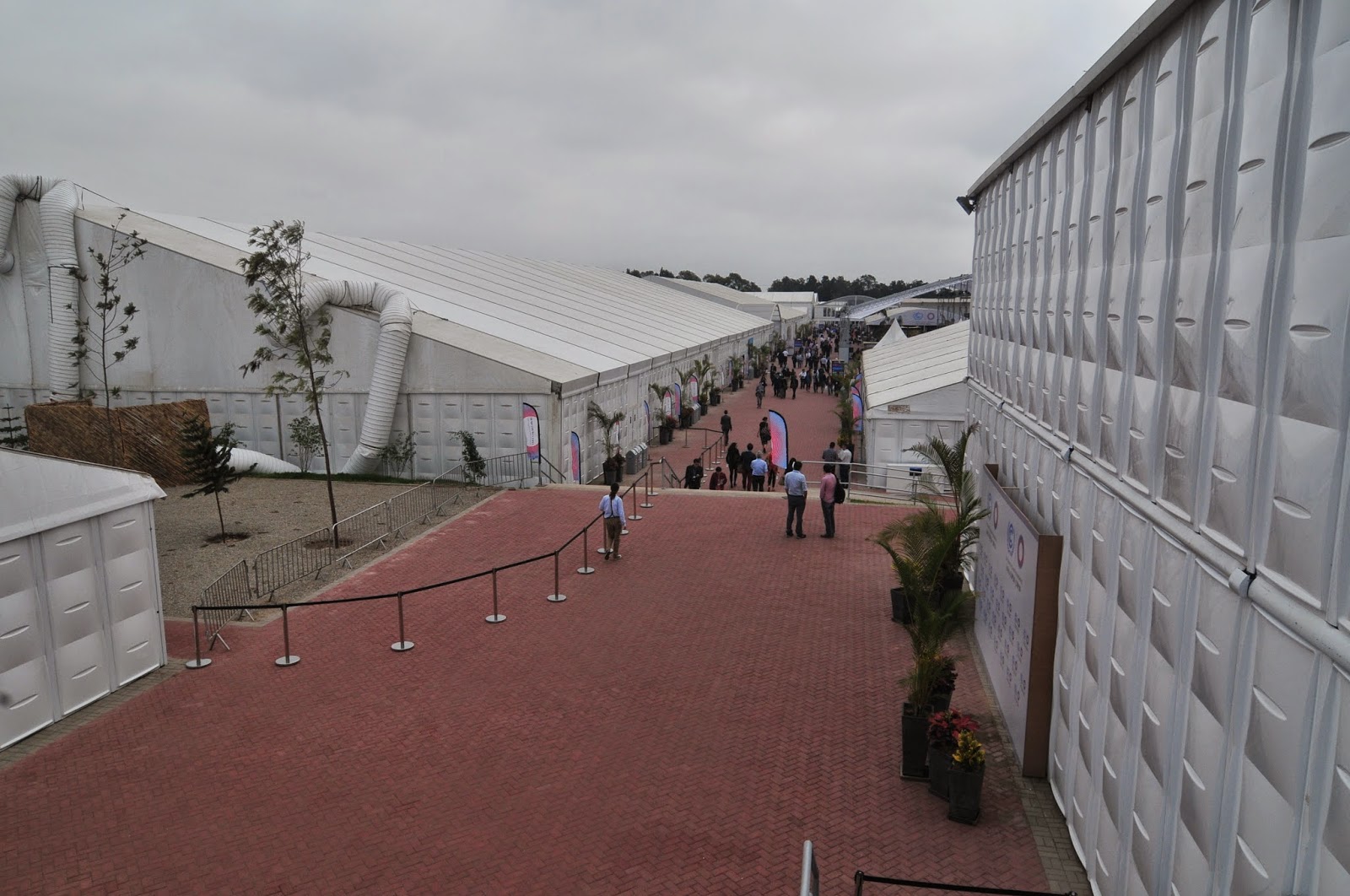
The conference was held on the grounds of a military base known as "El Pentagonito" (The Small Pentagon) and made up of a compound of large temporary buildings.


The event went smoothly, except for the bus rides from our hotel to the venue, which sometimes took over 90 minutes due to the traffic in Lima.


The breakdown was fun, as we had discovered our cables has been squeezed between two sheets of plywood over one of the conduit vaults and had an interlocking brick walkway installed over it.  There was not enough room for the fiber cable head to be extracted through the small space they left, so we improvised and used a screwdriver to break a hole in the plywood and remove the cabling. 


More photos HERE.

Sunday, November 23, 2014

Live Surgery in Vancouver, BC

Last week, DCI teamed up again with BoxLine Box medical media to bring high quality live surgery to the annual meeting of the AAGL, held in Vancouver, Canada.   While much smaller than the AUA event where we coordinate more than a dozen live surgeries, the AAGL event had its own challenges.

The entire receive-only flyaway, consisting of the 1.1m dish, two IRDs, spectrum monitor, handheld SDI generator and monitor, and a utility case of cables takes up only 3 cases, easily checkable on any airline.

The convention center told us "no has been successful getting satellite" to work reliably at the convention center, and they blamed it on radar from the nearby airport.  They suggested downlinking it at a Bell Canada facility in Toronto and fibering it across Canada.  This approach would take the quality control of the feeds out of our hands, something that has made our live surgery broadcasts the highest quality and most reliable in the industry.   During these conferences, DCI hires the local uplink trucks at each hospital, and provides quality control of encoding and RF parameters, coordinating with the uplinks to make adjustments as necessary to get the best balance of quality and margin. 


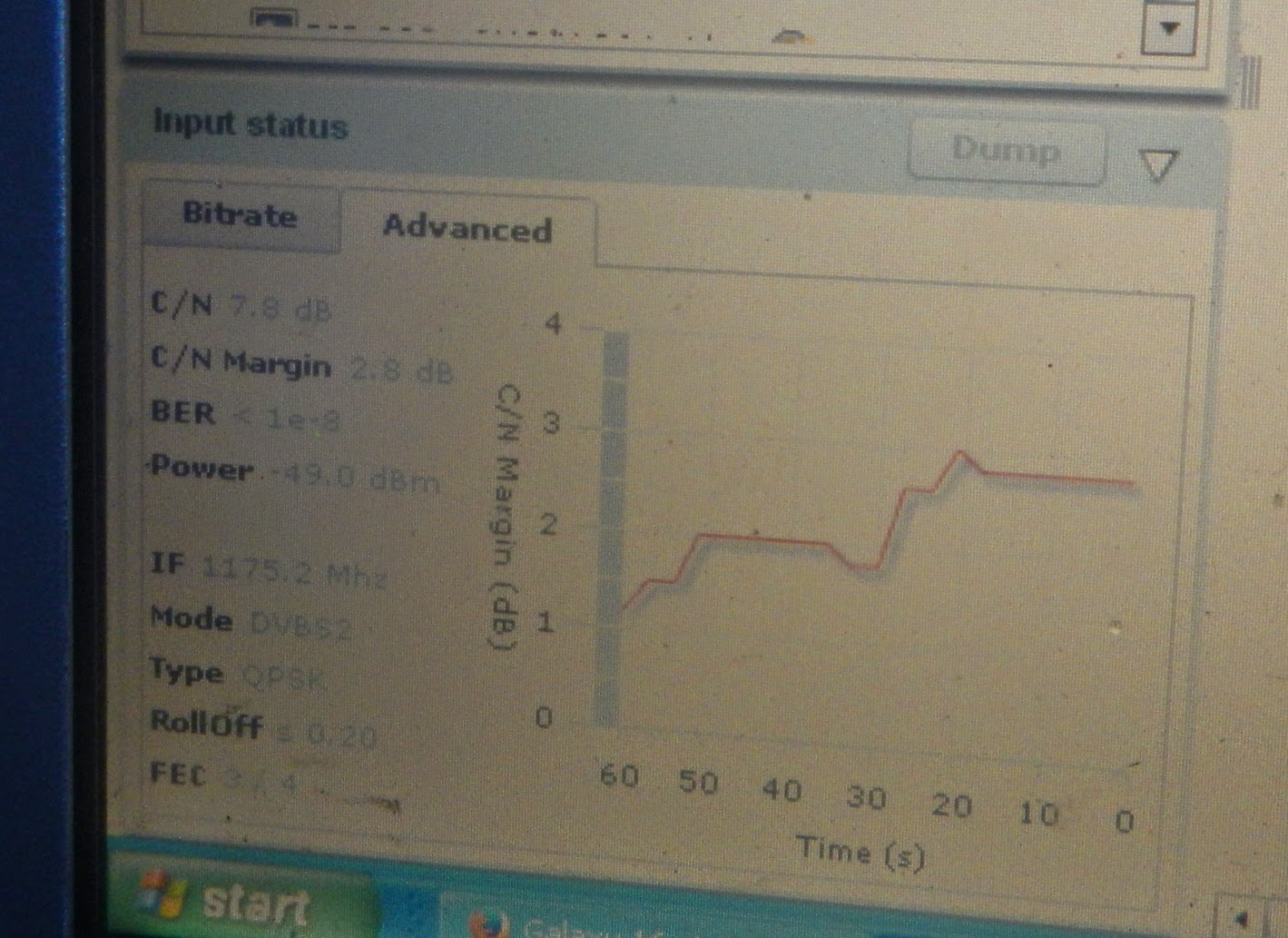
We came equipped with a 1.1m Ku flyaway and a expectation of having to make adjustments.  One of the biggest issues we had was with a smaller downlink dish and a high latitude location that made the satellites "stack" up on each other, and with the wide beamwidth of a 1.1m dish, we were getting a lot of adjacent satellite interference.  This could explain the trouble others have had at this location.  The portable spectrum analyzers we use don't have enough resolution bandwidth to really peak the adjacent satellite out, so we improvised by using the real-time margin graph on our Ateme IRDs to peak the signal for maximum C/N margin, regardless of what the spectrum looked like.  Its similar to how analog shots were peaked up years ago, by using a real-time signal strength meter on the receiver.

Our originally planned parameters of 8PSK 2/3 had insufficient margin, so dropping down to QPSK 3/4 gave us margins of around 4dB.  We planned for this and reserved more satellite bandwidth than we would use when downlinking in our 2.4m "HD1" satellite truck.

Our dish was set up directly above the Vancouver seaplane airport, one of the only seaplane bases in the world with a control tower.  This base serves dozens of scheduled flights to the islands in everything from vintage deHavilland Beavers to large twin turboprop float planes.  We even had time to take a quick tour in one of the 1964 deHavilland.  After the second live surgery was done, we packed up and headed to the airport, another flawless live surgery events in the books.


If you are interested in how DCI can bring this high level of transmission quality control and management of your corporate events, contact us.  If you need to produce a live event or recording of a live surgery in the unique setting of a working operating room, contact BoxLine Box.

More photos from this event


Friday, September 12, 2014

Wireless Cameras

Whenever Hollywood portrays live TV reporters, they one thing they always get wrong is there is never a cable going between the camera and truck.  A typical SNG cable reel is between 250-400 feet long, weighs 30-60 pounds.  It usually carries one or two video lines, plus several audio cables which in the past were used for microphones along with communications (IFB and Intercom), but now with digital SDI video and embedded audio, they are mainly just used for the comms.

 A little bit more than a typical SNG reel!

Within the past few years, heavy-duty tactical fiber optical cable has become popular, but that is another post!
SNG Fiber


Whenever a satellite truck is set up for a live shot, these cables have to be strung to the camera.  Sometimes it is simply just a few feet from the truck, other times the cable has to be run through a building, requiring an hour or more of hard work.

People often ask why it can't be wireless... after all they can stream video reliably over mobile phones, use WiFi, and a host of other wireless data services.  The main answer is unlike IP based streaming, which may have at least 30 seconds of delay built-in for error correction, wireless for live reporting has to be very low delay, otherwise the lag between reporter and anchor during talk-backs is very noticeable.  Also since it will be encoded again, very high bitrates are required. 


DCI is proud to be the only SNG company in the Washington area to own our camera-back microwave system, and one of the few SNG companies in the entire country to have a licensed microwave system of any kind.  Other systems use the crowded public WiFi bands of 5.4 or 2.4 GHz, but our system operates in a licensed band at 6.4 GHz, allowing better range resulting from less interference.

This is the same system we deployed as a fixed-position link every July 4th, but its most versatile when connected to the back of a roaming camera.  

This camera-back system is extremely useful when needing to cover an event where cabling is not possible, such as in Lafayette Park in front of the White House.  The only place to park a SNG truck is across a busy road, so covering protests inside the park require a wireless link like DCI's Campack system, or for crews without a wireless kit, going live from across the street, a far less appealing location.  Another use is when covering another popular Washington news event, a march to the Capitol.  By placing the truck at a central location and using directional antennas, we can have a mobile reporter go live while covering one of these marches.  Paired with a simple UHF wireless IFB system for reporter and camera, the camera-back transmitter gives DCI a unique edge when challenging live shots solutions are required.

LafayettePark live shot


Contact DCI to see how we can put our wireless systems to use for your next broadcast.

Monday, July 28, 2014

Cuba 2014


Working in Cuba is always an adventure!  When the Chinese president planned a visit to Cuba after the BRICS summit in Brazil, national broadcaster CCTV planned a large operation.  The president planned two stops- Havana, just 90 miles from Key West, and Santiago, about 500 miles away on the south-east coast.


CCTV insisted on full path diversity at both locations, that means two uplinks at each location, two different satellites, and  two discrete routes to China from the two receive sites US, using both fiber and satellite. 


Operating an uplink in Cuba requires copious amounts of paperwork and licenses, and two flyaways makes it twice as much!  After an eight hour wait to clear customs, we loaded our gear up on a 1934 Ford truck to carry it to the Nacional hotel in Havana.
 
The first kit used our first generation airline flyaway, a 1.1m Patriot connected to Xicom 400w transmitters in a 1:1 configuration.  The transmission plan called for SD MPEG-2 video broadcast a very high quality 16mbps with 4:2:2 compression using 8PSK modulation in a 9MHz slot.


Setup and testing went smooth, however CCTV requested a second path for live shots, which we able to support by combining a smaller 4.5 MHz signal on the uplink chain.  That path utilized H.264 compression and DVB-S2 QPSK modulation at 6 mbps.


At this time a second engineer arrived to take over operation of the Havana flyaway while the second system traveled 11 hours across the country to Santiago de Cuba.


The countryside has some of the best, freshest food in the country, and much cheaper than the cities. 

Upon arriving in Santiago we found a spot where we could get a shot (the only satellites covering Santiago are very far to the west, resulting in look angles much lower than you would expect for being so far south)


The Santiago flyaway was our new modified Norsat system, connected to a pair of linearized 400w BUCs, allowing us to locate the encoders far away under shelter.  After one day of feeding, we packed up and drove the 11 hours back to Havana, and hopped a cargo charter to Miami the next day.


Need a flyaway uplink in a difficult location, or just a SNG truck around town in DC?  Give DCI a call!


Sunday, July 13, 2014

July 4 Microwaves

 The famous PBS fireworks camera with a perfect view of the DC memorials.


DCI has been helping link up remote cameras for the PBS "A Capitol Fourth" concert show for more than 15 years.  What had once been a single SD analog microwave path has become two high quality HD feeds.  This year, with the loss of the Clocktower receive site to a hotel development project, we had to think of another way to send the cameras back to the production truck.

The first of two cameras was stationed at the Lincoln Memorial.  We used our normal 7GHz NuComm HD microwave transmitter in the van, but instead of it's internal MPEG-2 encoder, we encoded externally to take advantage of H.264 4:2:2 encoding for a better quality picture.

We took the ASI output of the encoder into the microwave transmitter running at 17mbps.  The second camera was located on a balcony of condo in Arlington and sends the famous shot of the memorials with fireworks above.  A NuComm receiver at that location received the Lincoln Memorial shot and outputted the compressed ASI directly into an ASI mux. Also feeding the mux was a second H.264 4:2:2 encoder with the memorials shot.

 
 We also downlinked the program feed off satellite to give return monitoring to the Lincoln camera operator.  
The resulting 34mbps ASI stream contained two services and was fed into a second NuComm transmitter and received at a rooftop in DC where we maintain a redundant 45mbps 38GHz link for a studio.  The NuComm receiver fed the multiplexed ASI stream into the 38GHz transmitter where it was received back at DCI, decoded into two HD-SDI streams and sent over Verizon fiber to the production truck on Capitol Hill.


45 mbps 38 GHz links, along with a long-range WiFi bridge connecting our DCI LAN to the microwave receiver on the rooftop. 


 Quad-Diversity antennas receiving the 2 channel mux microwave feed before sending to DCI over 38GHz (above)